
Exclusive IPD distributor for the Czech and Slovak RepublicsOriginal components · CAD/CAM libraries · technical support+420 604 483 343obchod@exklusiv-dent.cz
IPD USA · 3D printing and digital analogs

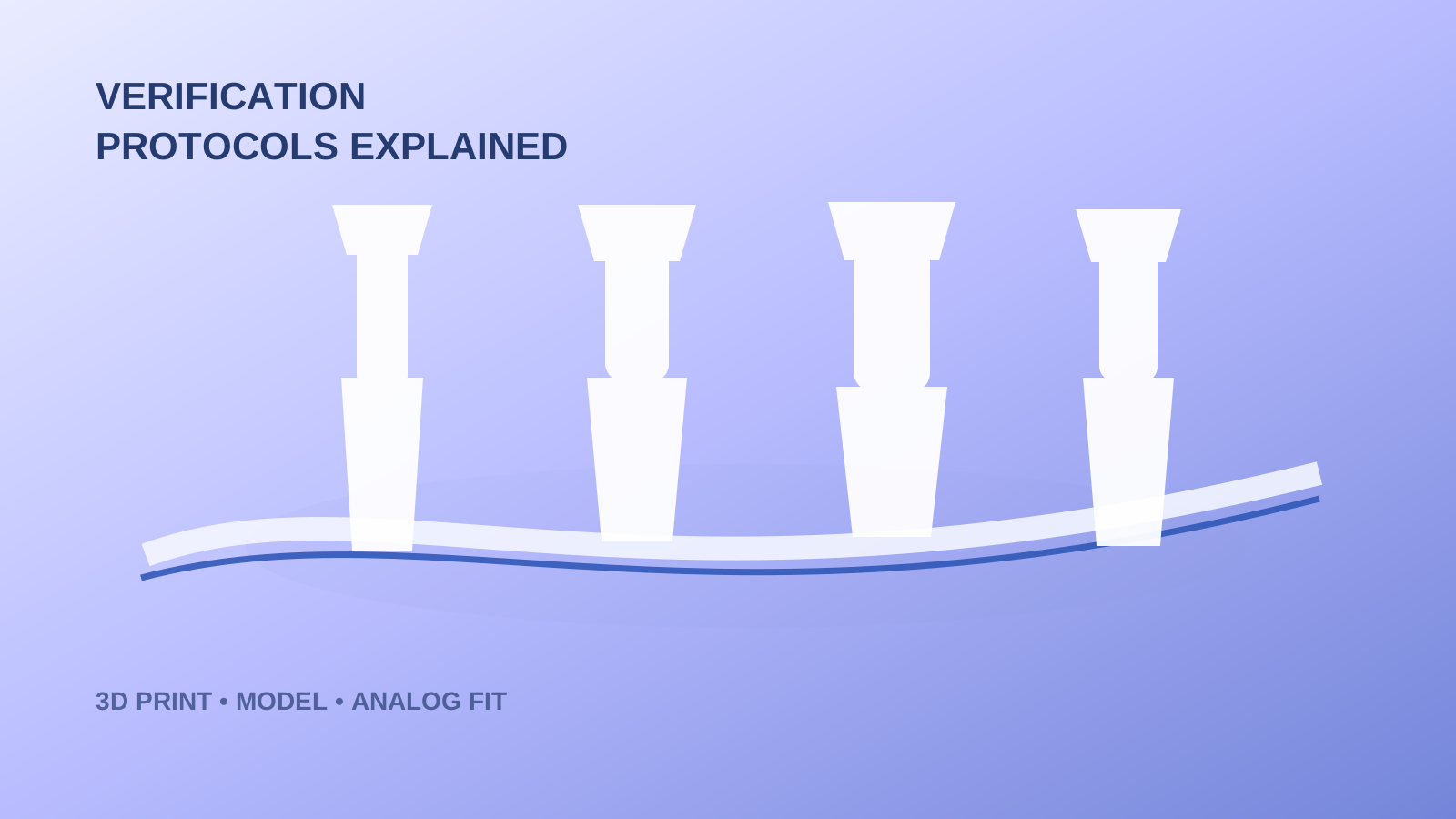
3D-printing verification protocol: how to verify digital-analog seating

Show where 3D verification sits in the workflowIPD Solutions Map · clinic ↔ laboratory

Printer resolution is not the same as accuracy of the implant model. The result is influenced by the resin, exposure, orientation, post-processing and calibration of the digital-analog receptacle.

Digital workflowEditorial translationPractical commentary
Verification of digital analogs in a 3D-printed model assesses repeatability of seating, stability and the effect of the printing process on the resulting geometry.
Editorial note: This English page is based on an educational article by IPD USA. The content has been translated, condensed and terminologically aligned with this website, while absolute marketing statements have been replaced with a more practical interpretation for the dental practice and laboratory.

Why the physical model must be verified

3D printing transfers the virtual design back into physical space. At this stage the result is influenced not only by the CAD file but also by the specific printer, resin, exposure, model orientation, washing and final curing. Even a small dimensional change in the receptacle can alter how the digital analog seats.

The verification protocol should therefore separate the “feeling that the analog fits” from a repeatable check. The aim is not to manually adjust every model, but to configure the workflow so that the same type of model behaves predictably within a specific printing setup.

Four sources of dimensional deviation

Resin and polymerisationThe material can change dimension during polymerisation and final curing. A catalogue value alone cannot predict the geometry of every receptacle.
ExposureOverexposure can enlarge geometric features, while insufficient exposure can weaken them. Stability of the parameters is important.
Orientation and supportsPrint orientation and the mechanical stability of supports influence both deformation and reproduction of detail.
PostprocessingWashing and final curing are not administrative steps. They can affect the surface and dimensional stability of the model.

Recommended verification procedure

  1. Print a verification geometry using the same resin, orientation and post-processing as the routine implant model.
  2. Verify analog seating without forceful insertion and without unwanted play or rotation.
  3. Record the configuration of the printer, material, layer thickness, exposure and curing so that the result is reproducible.
  4. Repeat the test after changing the resin or parameters. An old offset is not automatically correct for a new process.

What verification cannot do and why different control layers exist

Calibration of the 3D model cannot correct an error that already arose during scanning or scan-body assignment in CAD. It checks one specific stage. A correct result requires continuity between the scan, library, model and digital analog.
1 · Validation Master / local receptacleVerifies whether the specific digital analog seats correctly in the designed receptacle within the given printing workflow, without force, unwanted play or rotation. It does not verify the relative 3D positions of multiple implants in the patient.
2 · Implant-level verification jig / global geometryA rigid jig created on the implant-level model can be tried clinically on the actual implants. It is an independent verification layer that can reveal a clinically significant discrepancy in the overall model geometry. It is not metrological proof of micrometre-level accuracy.
3 · Definitive attachment-level transferAfter clinical selection of PSD / Locator-compatible abutments, their actual intraoral positions can be transferred by a separate scan or elastomeric impression. This step answers a different question from validation of the implant-level model.

For a removable hybrid restoration, the resulting chain may therefore be local analog validation → global clinical verification of the implant-level model → definitive PSD-level transfer. Each gate controls a different part of the uncertainty.

Open the three possible transfer pathways for a hybrid PSD restoration →

Related pages

Original source

Rafael Saucedo: Verification protocols explained: ensuring accuracy in dental implants 3D printing, IPD USA, 2026.
Open the original IPD USA article ↗

e-dent logo

I am a professional within the meaning of Section 2a of Czech Act No. 40/1995 Coll., on the Regulation of Advertising. I confirm that I am authorised to access pages intended for professionals.