

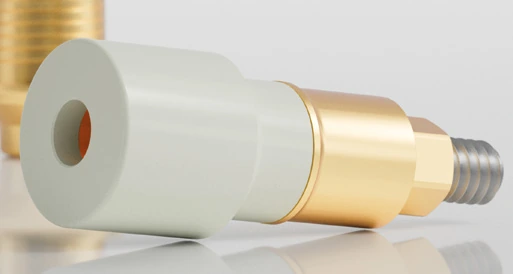
Sterilisation and metrological repeatability are two different validations
A scan body may be processed correctly from a hygiene standpoint yet fail to provide identical metrological information after repeated use. Sterilisation addresses microbiological safety. Metrological repeatability addresses the stability of seating, axis, anti-rotational orientation and surface geometry that CAD software compares with the library STL.
For an IPD Scan Abutment, it is therefore essential to work with the exact reference and current instructions for use. Official instructions specify PEEK / Grade 5 Ti6Al4V titanium, hand tightening or a maximum of 10 Ncm, and warn that excessive tightening may alter scan-body geometry and cause scanning errors. For intraoral use, the component must be sterilised before use in accordance with the current IFU and the labelling of the specific reference.
PEEK versus titanium: both optical and mechanical differences matter
PEEK offers a matte, low-reflectivity surface that is advantageous for optical scanning. Titanium provides high stiffness and resistance to mechanical wear, but its optical behaviour depends strongly on surface finish. Modern studies therefore do not support a simple conclusion that “PEEK is more accurate” or “titanium is more accurate”.
In one 2025 study, PEEK achieved better overall results than titanium, with the outcome depending on the specific IOS and angulation. Another 2025 experiment found better depth accuracy for polished and sandblasted titanium than for PEEK. Reuse introduces another variable: PEEK may be more sensitive to mechanical changes, whereas titanium may retain geometry more robustly, but a number of reuse cycles cannot be transferred universally between products.
The result is a function of material, surface, scan-body geometry, length, implant angulation, IOS, scanning strategy, tightening, wear and library alignment. Material is only one variable in the complete measurement chain.
Recommendations for clinical and laboratory practice
- Base sterilisation and reuse exclusively on the current instructions for use and labelling of the specific reference. Information on this website does not replace the manufacturer’s IFU.
- Follow the specified tightening protocol and always verify complete seating on a clean implant or abutment platform before scanning.
- Before reuse, inspect edges, surfaces, the PEEK section, screw and implant interface for damage.
- If repeatability drift is suspected, compare multiple scans of the same component using the same torque and library tolerance. Do not change several variables at the same time.
- High-volume centres may benefit from an internal acceptance protocol for retiring scan bodies, without exceeding reuse permitted by the manufacturer.
Interpretation limits
Primary and manufacturer sources
IPD Dental Group: Instructions for Use, Scan Abutment: sterilisation, PEEK / Ti6Al4V material and maximum torque of 10 Ncm.
Hashemi et al., 2023: Effect of Repeated Use of Different Types of Scan Bodies on the Accuracy of Implant Position Transfer.
Ben-Izhack et al., 2024: Post sterilization of intraoral scan body and the effect it has on positional changes.
Baranowski et al., 2025: Effects of scan body material, length and top design on digital implant impression accuracy.
Ata et al., 2026: Effect of Material, Sterilization, and Repeated Use on the stability of monoblock titanium and PEEK scan bodies.
Check the current IPD instructions
For clinical use, the manufacturer’s current instructions for use and the labelling of the specific reference always take precedence.