

English technical abstract
The article starts from a practical problem: intraoral scanning of multiple implants remains highly dependent on the operator and arch geometry. Distal regions, the edentulous mandible and long surfaces without distinct landmarks can interrupt the scan and lead to incorrect mesh stitching.
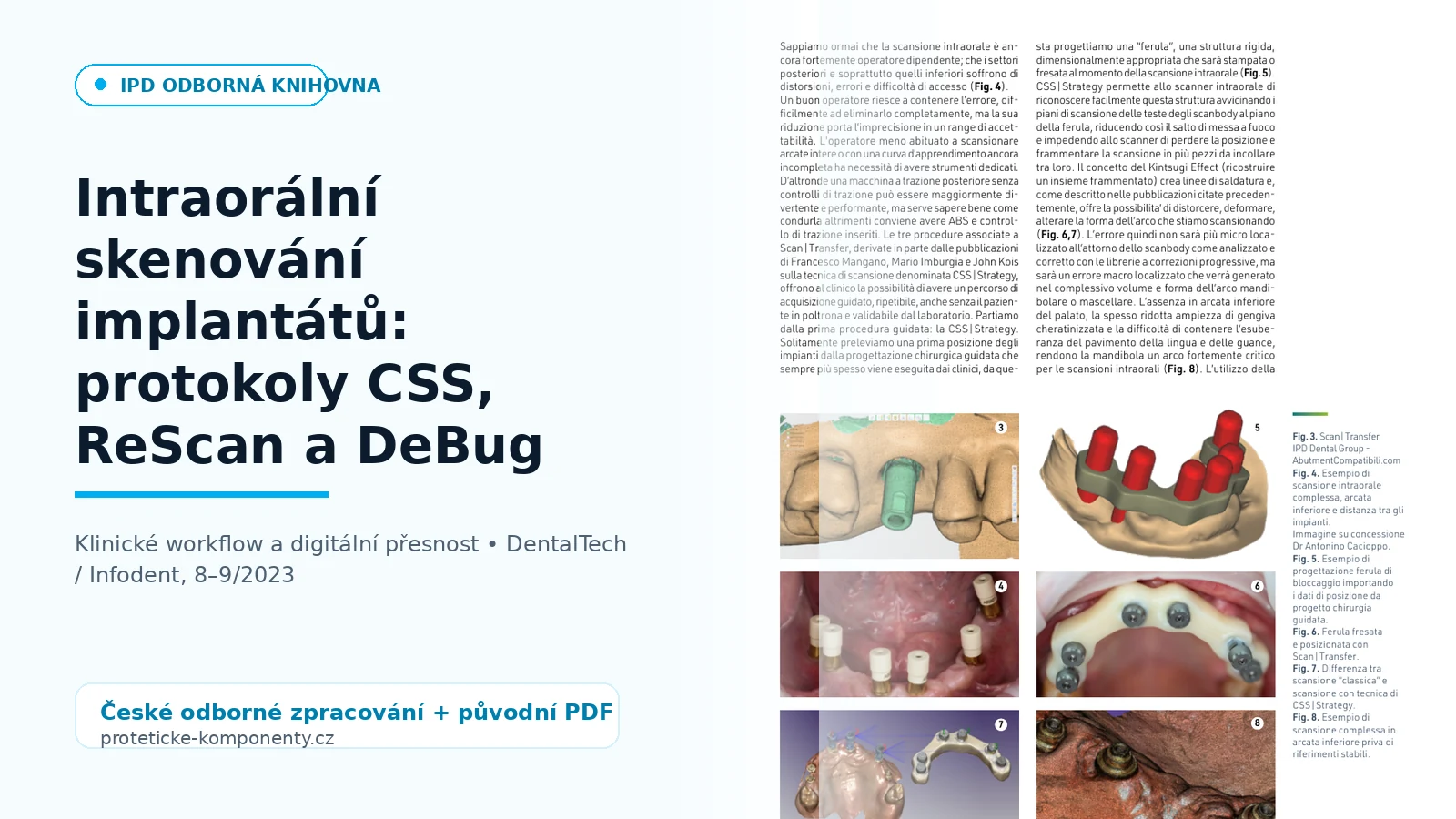
ScanTransfer enables rigid connection of implant references and then supports three protocols. CSS Strategy simplifies the scan path; DeBug creates an independent physical master and returns analogue certainty to the digital workflow; ReScan allows difficult implant positions to be acquired extraorally and linked to the easier intraoral part of the record.
What the article shows
The three protocols are not variants of the same procedure. Each addresses a different phase.
CSS Strategy
Problem: the scanner loses orientation and creates multiple fragments.
Intervention: a rigid, easily readable structure connects the scan bodies and shortens the complex intraoral path.
Output: a more continuous mesh with fewer critical stitching seams.
ReScan
Problem: a distal segment or limited mouth opening prevents stable acquisition.
Intervention: the reliable intraoral fragment is retained and the rigid assembly is rescanned accurately extraorally.
Output: implant positions from a more comfortable acquisition while preserving their correct relationship to tissues and occlusion.
DeBug
Problem: the same digital workflow cannot reliably identify its own systematic error.
Intervention: creation of a stone or other physical validation reference with analogs.
Output: an independent check of the design, milled restoration/framework and bonded Ti-bases.
What this means for the laboratory and clinic
- Before scanning, determine whether the main risk is arch length, distal access, insufficient landmarks or the inability to perform independent verification.
- Create the rigid connection without micromovement or deformation during polymerisation or handling.
- With ReScan, preserve reliable overlapping areas for accurate registration of the intraoral and extraoral meshes.
- Do not view the physical validation key as a step backwards, but as an independent measurement channel.
The content complements the ScanTransfer and ScanLogiQ product pages by explaining specifically when to use each protocol. Internal links guide users from the problem to the component, library and validation step, strengthening both UX and the site's topical authority.
Limitations and cautious interpretation
Original source article
Original title: La scansione intraorale su impianti: nuovi protocolli di lavoro
Authors and source: Nicola Palladino; professional introduction by Francesco Mangano; DentalTech / Infodent, 8–9/2023.
Download the original PDF
The original Italian document contains the complete text, image documentation and any bibliography included by the authors.
Related IPD pages and workflows
Glossary of technical terms
- CSS
- Continuous Scan Strategy, a continuous scanning-path strategy.
- extraoral scan
- Acquisition of an object outside the mouth, often under more accessible and stable conditions.
- rigid splinting
- Rigid connection of multiple reference elements without relative micromovement.
- alignment
- Computational registration of two 3D data sets using shared geometry.